Airport Portrait Panorama
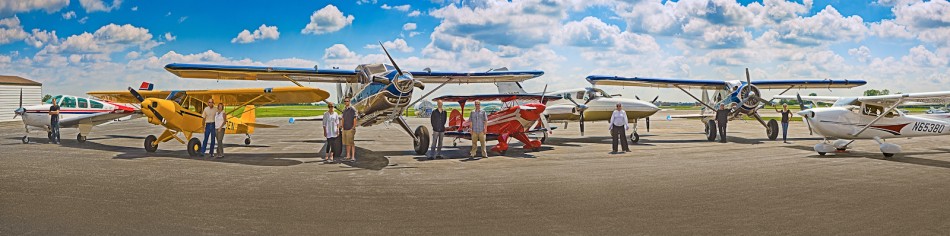
Over the summer I spent several weeks documenting a family in Chicago. We had only a few hours one day to get this shot of seven planes and the eight family pilots and their spouses. We came up with the idea on the day of the shoot so no pre-production. Three of the planes had to be flown in from other airports around chicago to our shoot location at the Dupage Airport. Once the airplanes where arranged and a private jet was moved out of the background we were ready to go, but we only had a few minutes to get the shot. It was a beautiful day, but as you can see by the shadows, not ideal lighting conditions. I tried to wait for a cloud -- but none would not cooperate. The panorama was shot in four pieces. My solution was to set up one flash head directly over the camera and rotate it (my assistant) on the axis of the camera lens. This gave me just enough light to open up the shadows. We were all extremely happy with the results, especially considering in was an impromptu shoot. The final image was put together from five exposures in Photoshop. It's hard to show how much detail is in this photo. Click on the photos below to see it bigger and broken into three parts.

Airplanes pictured from left to right: Beechcraft Bonanza, Piper Super Cub, de Havilland Turbo-Beaver, Pitts Special, Cessna 421 Golden Eagle, de Havilland Beaver, Cessna 172
For the tech geeks out there. The flash was a Speedotron 206VF head w/11" reflector connected to a Speedo 4803CX powerpack at full power (4800WS). For everyone else-- about equivalent to 10 or more on camera flash units firing at once ( flash guide number of 1000 with this reflector).
Posted via email from Philip Nealey
The Baker, Flour and Dough
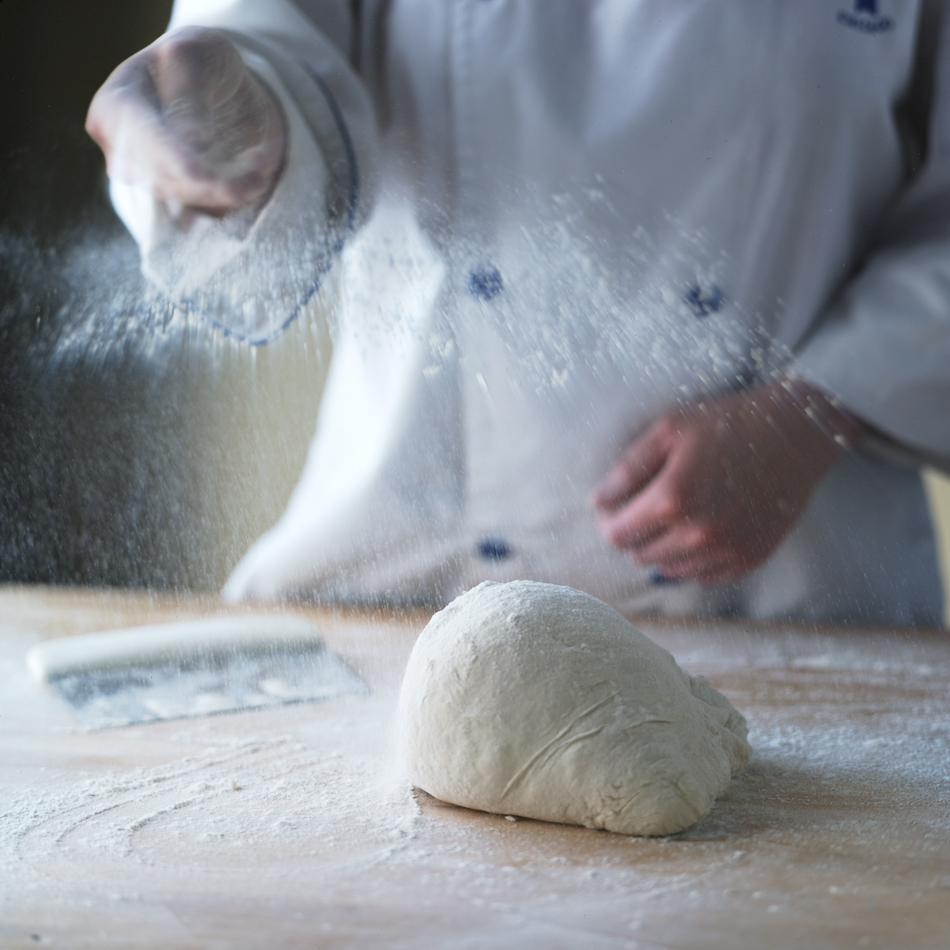
This is one of my favorite photos. It was shot in the studio to look like it was natural light however I used strobes*. It was originally done as a portfolio image but has always sold well as a stock photo.
You can license it as a stock photo at Getty Images HERE
*For those of you interested in the technical details: This was shot with a 6x6 silk(diffusion panel) to the left and a white foamcore flat for fill on the right. For several shots in this series I used two Speedotron heads positioned to shoot through the silk and changed their position depending on the look I was after. I sometimes gelled the head in front warmer and the one in back cooler. Where the light overlapped they in effect canceled each other out but added depth of color to my eye. I think it also gives the effect of the mixed lighting you might encounter on a location with warmer interior lights and cooler window light (just the thing we try to eliminate on location). The effect can be very subtle as in the above shot or can be more pronounced depending on the subject and how you position the lights (and of course how much you gel the lights).
Portrait: Should I take off my glasses?
Many times people ask me if they should take off their glasses for a photo. I always tell them no — if you're wearing glasses during the photo session, you most likely wear them all the time. When people take them off they feel exposed, they squint, and they're generally less comfortable. Glasses become a part of your persona. When I'm taking a portrait I want to capture everything that makes you, you. I also personally feel glasses can add interest to the photo. I really like the reflection on Jared's glasses in the portrait below. Because we had mixed lighting in the room the reflection from the windows is very blue while the rest of the image is made up of warmer tones. His eyes are also not obscured by the reflection — if they were, it just wouldn't work. As for taking the lenses out of the frames, that just looks strange to me.
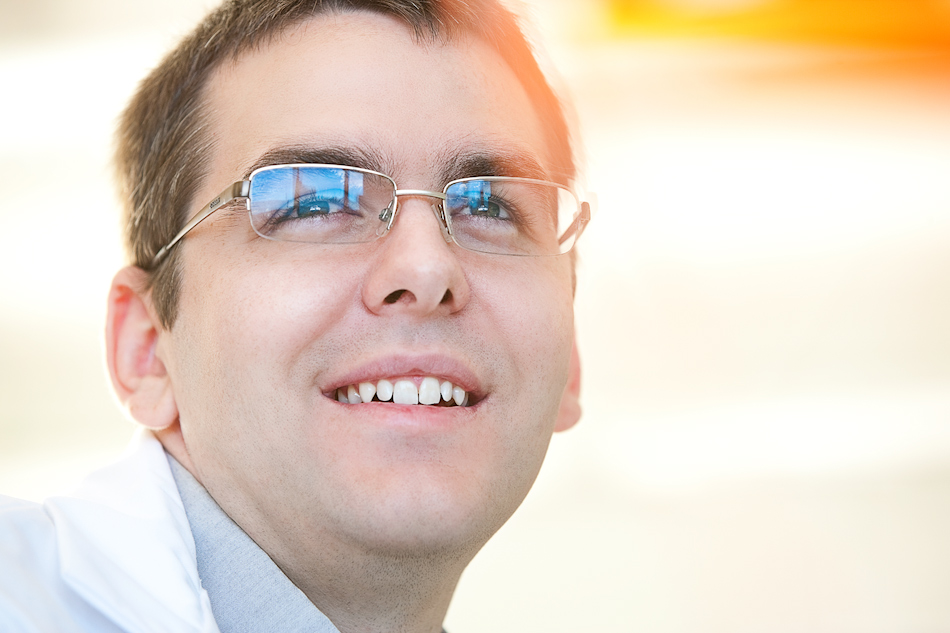
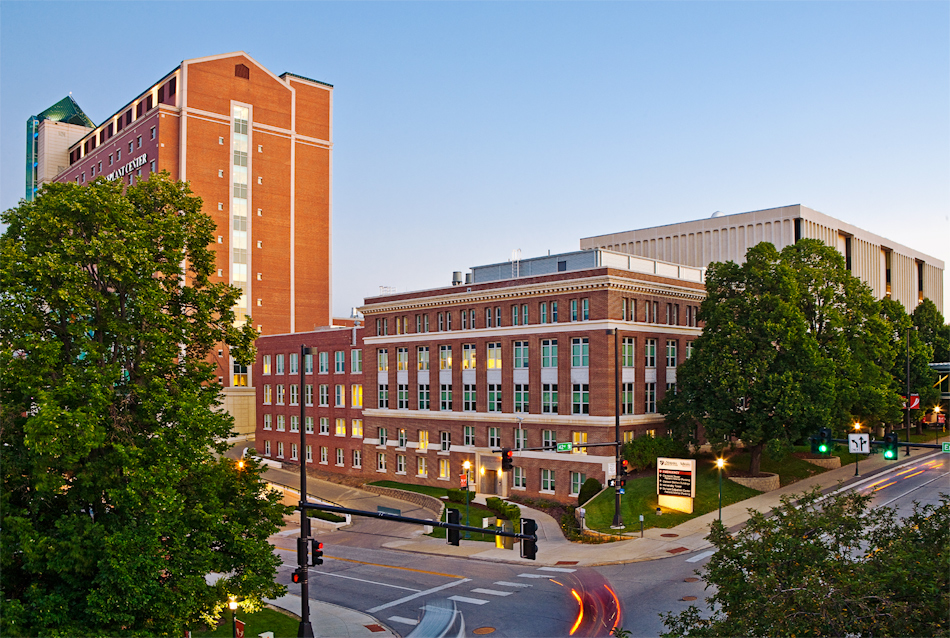
Photo: Bennet Hall exterior
A talented landscape photographer once told me the only difference between his photos and the average person is that he got up at 3 a.m. -- slight oversimplification however point well taken. For the architectural exterior photo below I did need to get up about 4:30 a.m. to set up before the sun rose a little before 6 a.m. (need time for coffee to take effect).